KIERSTEN

JACKSON

MORTGAGE BROKER

Mortgage Minute

Mortgage Choices

Open vs. Closed Mortgage: What’s the Difference?

Most borrowers use a closed mortgage. An open mortgage usually comes into the conversation when someone expects to pay the mortgage out again fairly soon.

5 min readUpdated October 2026
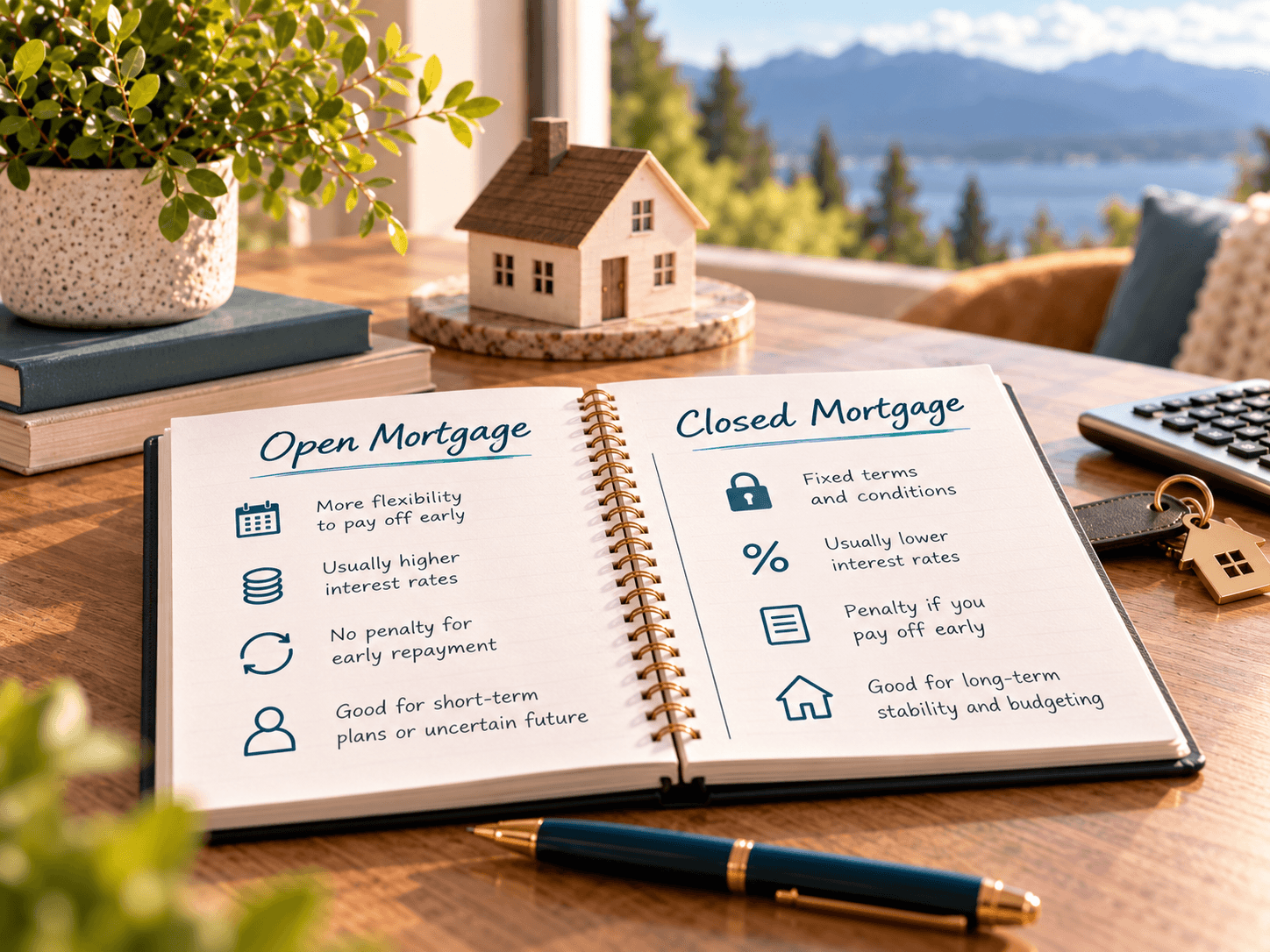
Open and closed mortgage options compared in a mortgage planning notebook

Quick Answer

Most people use a closed mortgage. An open mortgage is usually a short-term option when being able to pay the mortgage out without a prepayment penalty matters more than getting the lowest rate.

Closed mortgages generally have lower interest rates and still usually include some ability to make extra payments.

Open mortgages give you much more freedom to pay down or pay off the mortgage before the end of the term, but the rate is usually higher.

That extra flexibility can make sense when you already expect the mortgage to be temporary.

The Main Difference

Most mortgages are closed. Open mortgages solve a different problem.

The difference is mainly about how much freedom you have to repay the mortgage before the term ends.

Closed Mortgage

The more common option for everyday mortgage financing.

  • Usually has a lower rate than a comparable open mortgage
  • Normally includes some prepayment privileges
  • Limits how much extra you can repay without a penalty
  • Breaking the mortgage early may result in a prepayment penalty
For most borrowers who expect to keep the mortgage for the term, a closed mortgage provides enough flexibility.

Open Mortgage

Usually used when the mortgage is expected to be temporary.

  • Can generally be paid out early without a prepayment penalty
  • Allows more freedom to make extra payments
  • Usually comes with a higher interest rate
  • Can be useful when you expect to refinance or sell soon
The higher rate may be worthwhile when avoiding an early-payout penalty is more important than the rate itself.

Planning Insight

Why This Matters

I do not often see someone choose an open bank mortgage simply because they want more flexibility.

More often, there is a reason the mortgage only needs to be in place for a short period.

That changes the conversation. Instead of asking which mortgage has the lowest rate, we are looking at what the mortgage will cost between now and the point when you expect to pay it out.

The Usual Choice

Why Are Most Mortgages Closed?

For most borrowers, a closed mortgage makes more sense because the interest rate is usually lower.

Closed does not mean you cannot pay the mortgage down faster. Many lenders allow you to increase your regular payments, make lump-sum payments, or use a combination of both.

The limits vary by lender and mortgage product, so the prepayment privileges are worth comparing along with the rate.

The restriction becomes more important when you want to pay out the entire mortgage before the end of the term. That is when a prepayment penalty may apply.

Example

A Regular Five-Year Mortgage

Imagine you are arranging a mortgage and expect to stay in the home for the next several years.

You would still like the option to put extra money toward the mortgage when you can, but you do not expect to pay the whole mortgage out in the near future.

In that situation, a closed mortgage with good prepayment privileges may give you the flexibility you need without paying the higher rate that normally comes with an open mortgage.

Short-Term Flexibility

When Would You Actually Use an Open Mortgage?

An open mortgage tends to make more sense when you already know there is a good chance the mortgage will be paid out relatively soon.

One common example is someone whose mortgage is coming up for renewal but who expects to sell the home in three or four months.

Renewing into another closed term could create a prepayment penalty when the home sells. An open mortgage may cost more each month, but it can allow the borrower to pay it out once the sale completes without that penalty.

Whether that is the better option depends on the rate difference, how long you expect to keep the mortgage, and what the penalty could be under another option.

Between Two Mortgages

What If Your Refinance Completes After Your Mortgage Matures?

This is another situation where an open mortgage can be useful.

Your current mortgage may reach its maturity date before your refinance with the new lender is ready to complete.

Rather than locking into a new closed term that you already know you plan to leave, an open option may give you somewhere to temporarily park the mortgage until the new financing is ready.

The open rate may be higher, but if the mortgage will only be there for a short time, the total cost can still make more sense than taking a closed mortgage and paying a penalty to leave it.

Private Lending

Open Mortgages Are More Common in Private Lending

Open terms come up much more often when I am working with private mortgages.

That is because private financing is often meant to be temporary. There is usually an exit plan from the beginning, such as refinancing back to a bank or another lender once the borrower is in a stronger position.

Some private lenders may make the mortgage fully open after an initial period, such as three months. Others may offer an open option but charge a higher interest rate for it.

Private mortgage contracts vary, so it is important to look beyond the rate and understand exactly what happens when you are ready to leave.

The Exit Strategy

The Cost of Getting Out Matters Too

With a private mortgage, I want to know how you are getting out of it before you go into it.

If the plan is to refinance in six months or a year, the terms around early repayment can have a real effect on the total cost.

A lower rate does not automatically make one private mortgage cheaper if another lender gives you more flexibility when it is time to refinance.

Worth Checking

Before taking a private mortgage, look at the rate, lender fee, term, minimum-interest requirements, prepayment rules, and what it will cost to pay the mortgage out when your exit strategy is ready.

Looking at the Cost

A Higher Rate Is Not Always the More Expensive Choice

It can feel strange to deliberately choose a mortgage with a higher interest rate.

But if you know you are likely to pay the mortgage out in a few months, the rate is only one part of the calculation.

You also need to consider how long you will actually have the mortgage and what it could cost to break a closed mortgage during that same period.

Sometimes paying a higher rate for a short time can cost less overall than taking the lower rate and paying a significant penalty shortly afterward.

Example

Renewing Before a Planned Sale

Suppose your mortgage matures in January, but you expect to sell your home in April.

You could renew into another closed mortgage at a lower rate, but you may need to break that mortgage only a few months later when the property sells.

An open mortgage may have a higher rate during those few months, but it could allow you to pay the balance out after the sale without a prepayment penalty.

The right answer comes from comparing the actual cost of both options rather than looking at the interest rate alone.

Before You Decide

What Should You Compare?

Start with how long you realistically expect to keep the mortgage.

Then compare the interest rate, the available prepayment privileges, the possible penalty under a closed mortgage, and any other costs involved in paying the mortgage out.

If the mortgage is intended to be temporary, the exit matters just as much as the entrance.

If you expect to keep the mortgage for the term, a closed mortgage will usually be the more natural place to start.

Frequently Asked

Common Questions

Clear answers to some of the most common questions about this topic.

An open mortgage generally allows you to make extra payments or pay the mortgage off before the end of the term without a prepayment penalty. That flexibility usually comes with a higher interest rate than a comparable closed mortgage.

A closed mortgage has limits on how much you can repay during the term without a penalty. Most still include some prepayment privileges, such as lump-sum payments or the ability to increase your regular payment.

Usually because they expect to pay the mortgage out soon. For example, someone may be selling their home in a few months, or a refinance with another lender may not complete until after their current mortgage reaches its maturity date.

They are available, but most borrowers do not choose an open mortgage for their regular long-term financing because open rates are usually higher. They tend to be used when short-term flexibility is particularly important.

Some are, but private mortgage terms vary considerably. A private mortgage may be fully open, may become open after an initial period, or may offer an open option at a higher rate. The mortgage may also have minimum-interest requirements or other early-payout terms, so the contract needs to be reviewed carefully.

No. Open or closed describes the rules around prepayments and paying the mortgage out early. Fixed or variable describes how the interest rate works. A closed mortgage can be fixed or variable.

Personal Guidance

Sometimes the Higher Rate Is There for a Reason.

If your mortgage is coming up for renewal and you expect to sell, refinance, or move to another lender soon, I can help you compare the short-term cost of an open mortgage with the potential cost of locking into another closed term.

Need a Second Opinion?

I can help you work through the numbers and the next step.

Ask a Mortgage Question