Mortgage Qualification
What Are GDS and TDS Ratios?
These are two of the numbers lenders use to compare your income with the cost of the home and your other monthly debts.
Quick Answer
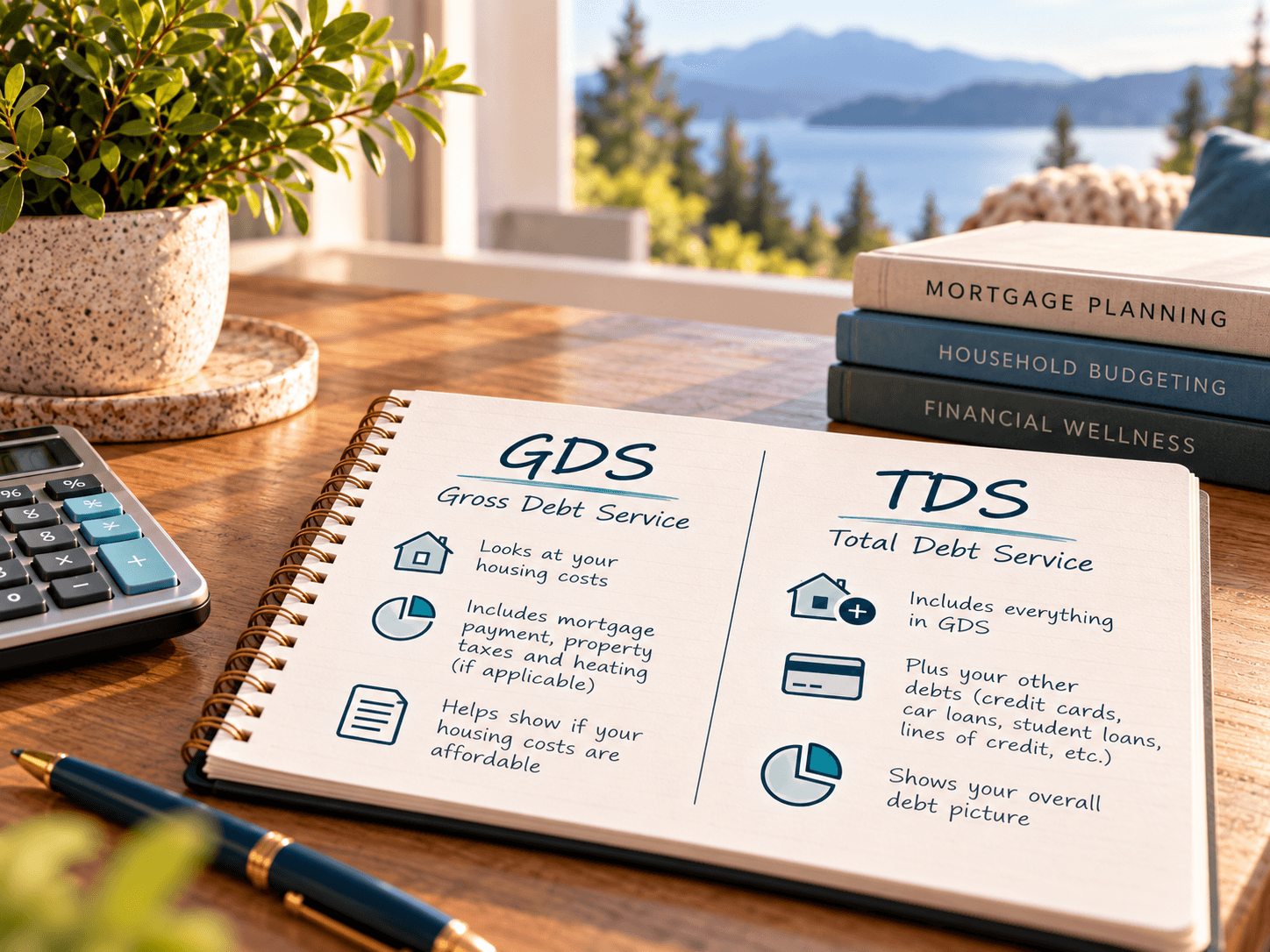
GDS and TDS are debt servicing ratios. They are simply a way of comparing your gross household income with your monthly housing costs and other debts.
GDS looks mainly at the cost of carrying the home. TDS takes those same housing costs and adds your other monthly debts.
Lenders use both when looking at how much mortgage you may be able to qualify for.
Gross Debt Service
What Is GDS?
GDS stands for Gross Debt Service. It looks at how much of your gross household income is needed to cover the basic costs of the home.
This usually includes the mortgage payment the lender uses for qualification, property taxes, heating costs, and a portion of condo fees if there are any.
In simple terms, GDS is asking: How much of your income would be going toward the home itself?
Total Debt Service
What Is TDS?
TDS stands for Total Debt Service. It starts with the same housing costs used for GDS, then adds your other monthly debts.
That can include things like car loans, lines of credit, credit cards, student loans, and other regular debt payments.
TDS is really asking: How much of your income is already spoken for once the home and your other debts are included?
Example
A Simple GDS and TDS Example
Imagine a household earning $120,000 per year, or $10,000 per month before tax.
If the housing costs used for qualification total $3,200 per month, the GDS ratio would be about 32%.
Now imagine the household also has $650 per month in car loans, credit cards, or other debt payments. Their total monthly obligations would rise to $3,850, giving them a TDS ratio of about 38.5%.
The income did not change. The difference between the two ratios is the additional monthly debt included in TDS.
Planning Insight
Why This Matters
Two people with the same income can qualify for very different mortgage amounts.
Someone with very little monthly debt may have more room for a mortgage. Someone with a large car payment, credit card balances, or other monthly debts may qualify for less, even if their income is exactly the same.
This is why income on its own never tells the whole story.
Mortgage Qualification
What Ratios Do Lenders Use?
As a general planning guideline, many mortgage calculations use up to 39% for GDS and 44% for TDS.
The mortgage payment used in these calculations may be higher than your actual payment because lenders also have to qualify you using the mortgage stress test.
Those numbers are useful for estimating, but they are not a guarantee of approval. The lender, mortgage insurer, credit profile, type of income, property, and the rest of the application can all affect the final decision.
Helpful Tool
Estimate Your Own GDS and TDS Ratios
Use my GDS & TDS Calculator to see how your gross household income compares with your housing costs and other monthly debts.
What to Explore Next
Continue Exploring
Here are a few related answers, guides, and tools that may help you take the next step.
Personal Guidance
Still Have Questions?
Debt servicing ratios are useful for planning, but they do not always tell the full story. If you have a purchase price in mind, I can look at the actual numbers with you and explain what may be possible.
Need a Second Opinion?
I can help you work through the numbers and the next step.
Ask Kiersten a Question